
Ethiopia: The First Refuge of Islam — A Story the World Needs to Know Ramadan Edition | March 2026
Pr
A History Hidden in Plain Sight
As Muslims across Ethiopia and the world observe Ramadan this month — fasting from dawn to dusk, gathering in prayer, and breaking fast together with family — it is worth pausing to reflect on a truth that most of the world, and even many Ethiopians themselves, do not fully know.
Ethiopia was the very first country on earth to give refuge to Islam.
Not Saudi Arabia. Not Egypt. Not any of the great Arab nations that today consider themselves the heartland of the Muslim world.
Ethiopia.
And that act of shelter, justice, and human dignity — offered by an Ethiopian king over 1,400 years ago — helped save a young religion at the most vulnerable moment of its existence, and changed the course of world history forever.
The Year Was 615 CE — Aksum, Northern Ethiopia
Islam was barely five years old. The Prophet Muhammad (peace be upon him) and his earliest followers were being violently persecuted in Mecca by the ruling Quraysh tribe. Muslims were being tortured, killed, and stripped of their rights simply for their faith.
Facing the possible annihilation of his community, the Prophet made a profound decision. He did not send his people to Yemen. He did not send them to Persia or to Rome — the great powers of the time. He looked to Africa. He looked to Ethiopia.
He told his followers:
"If you were to go to Abyssinia, it would be better for you — for the king will not tolerate injustice and it is a friendly country, until such time as Allah shall relieve you from your distress." — Sirat Rasul Allah, Ibn Ishaq
And so approximately 83 men and 18 women — among them Uthman ibn Affan, the Prophet's own daughter Ruqayyah, and Ja'far ibn Abi Talib — boarded ships and sailed across the Red Sea to the Kingdom of Aksum, in what is today northern Ethiopia.
This was the First Hijra — the first migration in Islamic history.
King Ashama ibn Abjar — Al-Najashi, The Just King
The ruler of Aksum at the time was a Christian king known in Islamic history as Al-Najashi — the Negus. His birth name was Ashama ibn Abjar.
When Quraysh leaders followed the Muslim refugees to Ethiopia bearing gifts, demanding the king expel them, Al-Najashi refused to act without hearing both sides. He summoned the Muslims to his court and asked them to explain their faith.
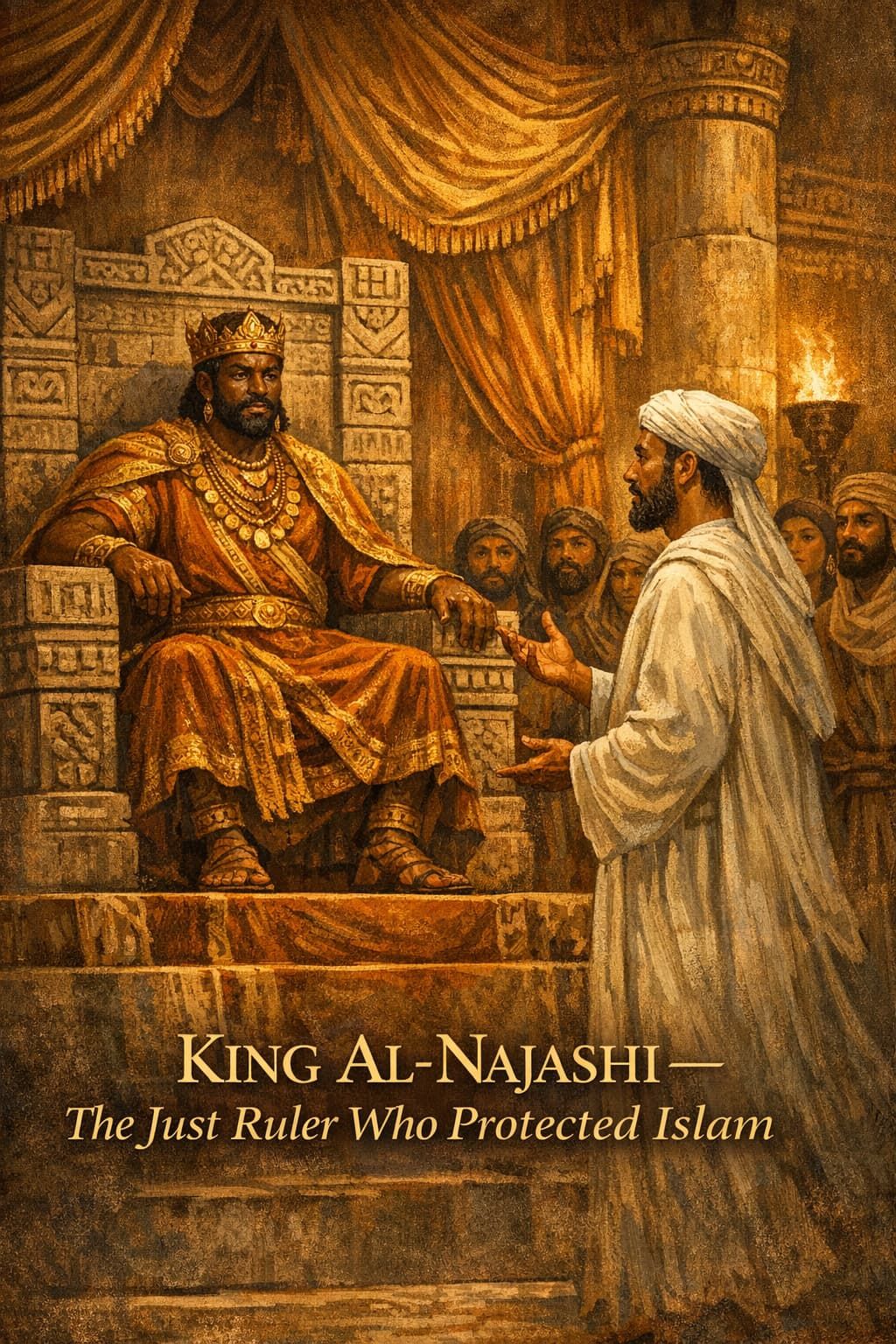
Ja'far ibn Abi Talib stood before the king and spoke:
"O King — we were plunged in the depth of ignorance. We adored idols, we ate dead animals, we spoke abominations. We disregarded every feeling of humanity. Then Allah raised among us a man of truth, honesty, and purity. He called us to worship Allah alone, to speak the truth, to be faithful, to be merciful, and to regard the rights of neighbors and family."
Al-Najashi then asked if they had any scripture with them. Ja'far recited verses from Surah Maryam — the chapter of Mary, honoring the mother of Jesus. The king and his bishops wept until their beards were wet.
The Negus then declared:
"Go — for you are safe in my land. Not for a mountain of gold would I harm a single one of you."
He returned the gifts to the Quraysh delegation and expelled them from his kingdom. The Muslims were free to worship, live, and practice their faith openly — for the first time in the history of Islam, on African soil, in Ethiopia.
The First Voice of the Adhan Was Ethiopian
The story of Ethiopia and Islam does not end with the Hijra. It runs even deeper.
Bilal ibn Rabah — the man chosen by the Prophet Muhammad himself to be the first Muadhin (the one who calls Muslims to prayer) — was Ethiopian. Born into slavery in Mecca, Bilal was of Abyssinian origin, with deep roots in the land we call Ethiopia today.
When Bilal's voice first rang out across Mecca with the words "Allahu Akbar" — the first call to prayer (Adhan) in Islamic history — it was an Ethiopian voice that carried Islam's most sacred summons to the world.
The first Adhan in Islam was called by an Ethiopian.
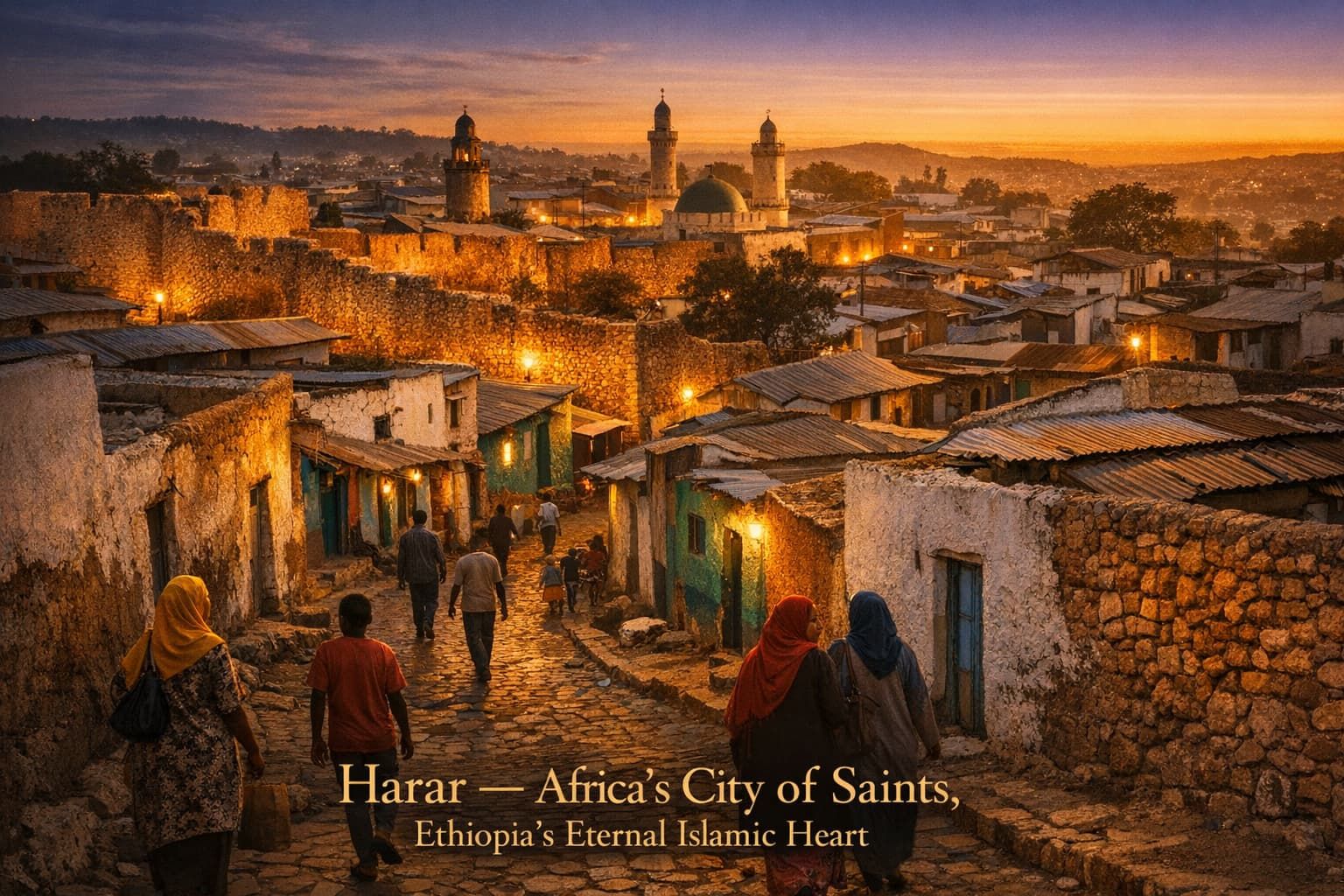
Harar — The City of Saints, Africa's Fourth Holy City
If Aksum was Islam's first refuge, then Harar is Islam's deepest Ethiopian root.
Located 500 kilometers east of Addis Ababa, the ancient walled city of Harar — known in Arabic as Madinat al-Awliyaa, the City of Saints — is widely considered the fourth holiest city in Islam, after Mecca, Medina, and Jerusalem.
Within its ancient walls — a UNESCO World Heritage Site — stand:
82 mosques, three of which date back to the 10th century
102 shrines dedicated to Islamic scholars and saints
A continuous tradition of Islamic scholarship dating back over a millennium
For centuries, Harar was a major center of Islamic learning, trade, and culture — connecting the Horn of Africa with the Arabian Peninsula, India, and beyond. Its scholars were read in Ottoman Turkey. Its coinage was its own. Its streets, still alive today, breathe 1,400 years of Muslim Ethiopian history with every step.
Ethiopia's Muslim Community Today
Today, approximately 35–40% of Ethiopia's population — over 45 million people — are Muslim. They are Oromo, Somali, Afar, Harari, Gurage, Amhara, and from dozens of other ethnic communities across the country.
Ethiopian Muslims are not newcomers to Islam. They are not converts from a later era. They are the original hosts of Islam — the people whose king, whose land, and whose justice made the survival of a young religion possible.
This Ramadan, as families across Addis Ababa, Dire Dawa, Harar, Jimma, and every corner of Ethiopia observe the holy month, they do so as inheritors of a legacy that predates the Islamic empires of the Arab world, predates the spread of Islam to Europe, and predates the faith's arrival in most of Asia.
Ethiopia did not receive Islam. Ethiopia sheltered Islam when it had nowhere else to go.
What This Means for Us — A Reflection from Jemo-Ande
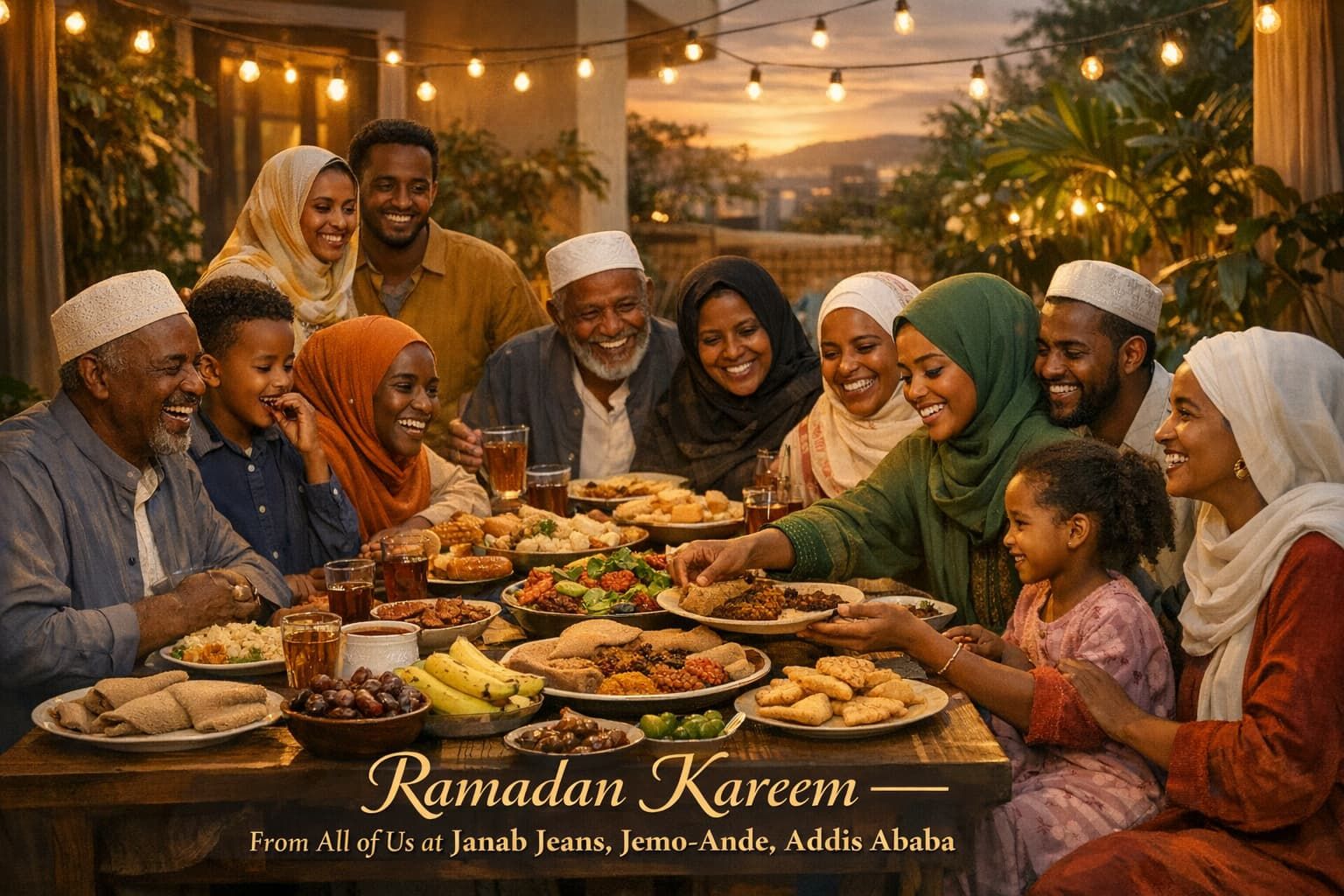
At Janab Jeans, we strongly believe that what makes Ethiopia truly extraordinary: not just only its landscapes or its coffee or its ancient history, but its centuries-long tradition of welcoming, protecting, and celebrating the full diversity of its people.
A brand rooted in Addis Ababa cannot be anything less than what Ethiopia itself has always been — a place of refuge, dignity, and belonging for all.
Ramadan Kareem to every one of our valued clients, neighbors, and community.
May this holy month bring you peace, reflection, and — when you need us — perfectly fitting clothes for every celebration that follows.
📍 Janab Jeans | Jemo-Ande, Addis Ababa 📞 +251 967 938 573 📧 [email protected]
#Ramadan Ethiopia 2026 #Islam in Ethiopia History #First Hijra Abyssinia #Al-Najashi King Aksum #Bilal ibn Rabah Ethiopian #Harar Holy City Islam #Ethiopian Muslims #Janab Jeans #Addis Ababa #Ramadan Kareem